

{noun} The total annual cost to borrow money, including fees, expressed as a percentage.
Annual Percentage Rate (APR)
March 22, 20233 min read
What is Annual Percentage Rate (APR)?
Annual percentage rate (APR) is the cost of borrowing money on an annual basis. APR is expressed as a percentage, to make it easier to compare the cost of credit.
APR and interest rate are sometimes used interchangeably, however, APR and interest rate are different. APR includes both interest plus fees applied over the course of a loan. Because APR is a more complete measure of the cost of credit, it is usually higher than the interest rate.
How is Annual Percentage Rate Calculated?
To calculate APR on a loan, you’ll need to know a few other numbers first:
Interest: The total interest charges paid over the life of the loan, also known as the cost of borrowing money.
Fees: Review the terms and conditions of the loan to find the fees that apply to your loan. Fees vary by loan type and lender.
Principal: The original loan amount.
Days in the Loan Term (n): Since APR measures the annual cost of borrowing money, multiply 365 (days) by the number of years in the loan term. For loan terms under one year, use the number of days.
The formula to calculate APR is:

The steps to calculate APR are:
Find the interest charges
Add the fees
Divide the sum by the principal balance
Divide by the number of days in the loan’s term
Multiply by 365
Multiply by 100
Credit Card APRs
Credit card APRs do not reflect fees and since a credit card has no set loan amount or fixed repayment term, its APR is simply its interest rate.
Under the Truth in Lending Act, passed in 1968, lenders and other financial institutions must disclose APR when offering credit.
Why is Annual Percentage Rate Important?
Knowing the annual percentage rate helps you understand the true cost of borrowing.
For example, all lenders are required to disclose APR, which makes it easier to compare loans from different banks and make a more informed borrowing decision.
Are There Different Types of APRs?
There are different categories of APRs depending on the type of financial product.
Credit Card APRs
Credit cards have several APRs that may apply to different transactions or account activities.
Purchase APR: The rate you pay for purchases.
Balance transfer APR: The rate applied if you use a card to pay down balances on other credit cards or loans.
Cash advance APR: The rate charged on ATM withdrawals or cash-equivalent transactions, like money-order purchases.
Introductory APR: A promotional interest rate for a limited period of time that is lower than the card's regular APR, sometimes as low as 0 percent APR.
Penalty APR: A higher-than-normal rate that results from violating a card’s terms of service.
What’s the Difference Between Fixed and Variable APRs?
APRs can be fixed or variable. A fixed APR remains unchanged for the life of your loan. A variable APR fluctuates in sync with a published market index, like the U.S. Prime Rate.
Adjustable-Rate Mortgages
Home loans with variable interest rates are called adjustable-rate mortgages (ARMs). With an ARM, your APR is fixed for an initial term (typically one, three, or five years, but sometimes as long as 10 years), then resets every six or 12 months, based on market rates.
What Affects APR?
The APR you're offered depends on a few factors:
Whether a loan or line of credit is secured or unsecured
Current economic conditions
Your credit history
Lenders may also consider your income and assets, down payment, and where you live when determining your APR.
How Do You Get a Good APR?
Getting the best APR on a loan or credit card typically requires shopping around.
Start by prequalifying with multiple lenders. Prequalifying is a quick process where you provide some basic information about your income and borrowing goal. Then, lenders respond with a preliminary, non-binding estimate of the loan amount and APR. This is typically done through a soft credit check, which doesn’t impact your credit.
Then, compare the preliminary offers and submit a full application to your lender of choice. With your detailed financial information and a hard credit inquiry, which will impact your credit, lenders can make a formal loan offer that includes your APR, fees, and repayment terms.
If you’re unhappy with the terms you’re offered (or if lenders decline your applications), your credit history might be the culprit. If this is the case, you can work to pay down your existing debts and bring late payments current, which can improve your credit score and chances for approval over time.
Personal Loans up to $60,000
Checking your rate won’t impact your credit score.2

You May Also Like
Related Articles
Debt consolidation replaces multiple high annual percentage rate (APR) balances with one fixed-APR personal loan. Before applying, knowing exactly what is owed, verifying that it actually saves money, checking your credit score, gathering documents, and checking your rate to see the actual APR before committing are important steps. This guide walks through each step in order.

Debt consolidation combines multiple high-APR debts into a single payment—ideally at a lower APR, with a defined end date. It can help save money and simplify your finances, but whether it makes sense depends on your credit profile, the APR you can qualify for, and your ability to avoid new debt after consolidation.
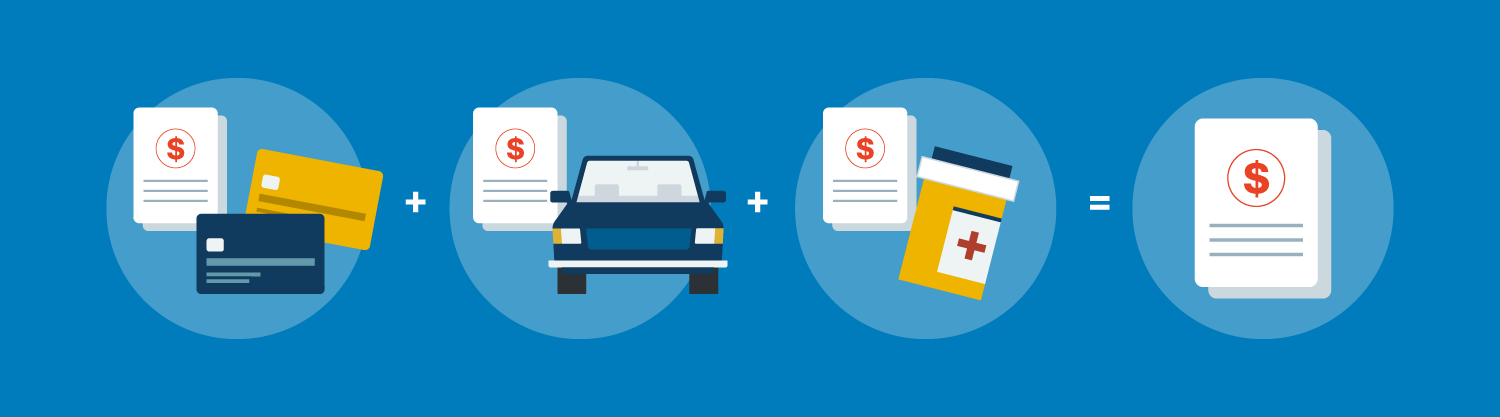
Applying for a personal loan may affects your credit score differently at each stage of the process: from the initial rate check through to full repayment. A personal loan can affect a credit score positively or negatively over time, depending upon several factors.

When you consider taking out a personal loan, there are two ways in which your rate can be structured. The choice affects not just your monthly payment, but the total cost of borrowing over the full term, particularly if your loan runs several years.
When people worry about debt consolidation hurting their credit, they’re usually thinking about how a loan application affects their credit score. What may negatively affect a credit score is a missed payment, a closed account that shortens your credit history, or new spending on the cards you just paid off.
Related Impact
Today, we are thrilled to announce the completion of our acquisition of Radius Bancorp, Inc. (“Radius”). In February 2020, we announced our intent to acquire Radius and shared how we can grow and deepen our customer relationships with a marketplace bank.

Today, we are thrilled to announce the completion of our acquisition of Radius Bancorp, Inc. (“Radius”). In February 2020, we announced our intent to acquire Radius and shared how we can grow and deepen our customer relationships with a marketplace bank.
Related FAQ's
You can view and manage most of your account information by signing in on the web or using the Happen Bank mobile app, including your password, phone number, physical address, loan documents, payment methods, and two-factor authentication settings.
Contact our team at 833-498-1399.
The Society for Worldwide Interbank Financial Telecommunication (SWIFT) Code is a unique identification code that may be required by some banks, broker-dealers, and investment managers for the completion of international wire transfers.
Personal Banking Customers: Our Elite and Reserve Tier customers can place a wire via Online banking or the Happen Bank Mobile app. For all other customers, they can reach out to Customer Service at 800.242.0272 to initiate a wire.
LevelUp Savings is a high-yield savings account that rewards you with a higher LevelUp Rate when you make deposits of at least $250 per statement cycle.
Related Glossary
{noun} A type of credit that allows the borrower to make charges and payments against a set borrowing limit, paying interest only on outstanding balances.
{noun} The amount of unpaid interest that has accumulated as of a specific date, either on a loan or an interest-bearing account or investment.
A debt that is written off as a loss because the financial institution or creditor believes it is no longer collectible due to a substantial period of nonpayment.
{noun} An interest rate that remains the same for a set time, usually for the life of the loan.
{noun} A loan used to pay off one or more debt accounts, usually to change interest costs, monthly payment, and/or payment term.


